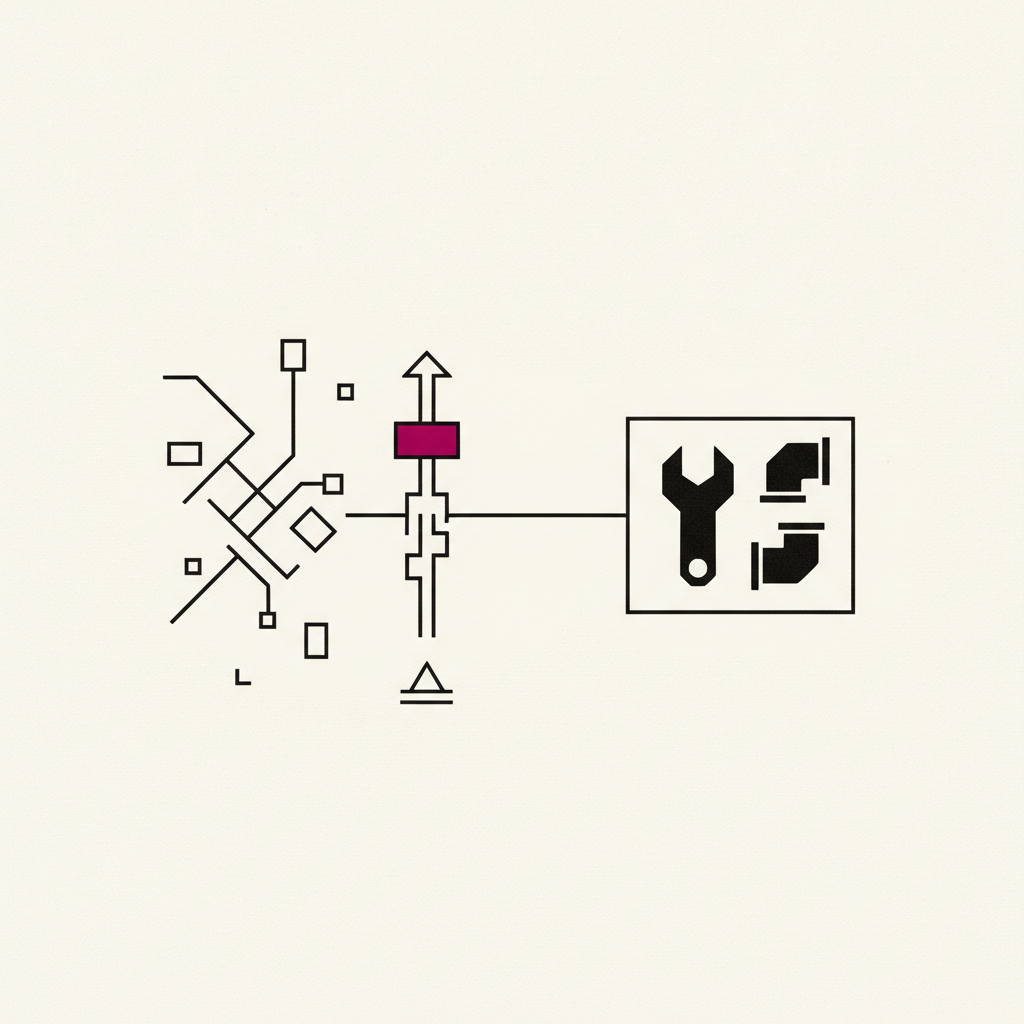
AI can help an HVAC, plumbing or electrical company, but fix the leaks first
Everybody is trying to work out where to use AI in an HVAC, plumbing or electrical business, and that makes sense. If you are looking at AI for HVAC, plumbing or electrical work, it can help you stay competitive in a tough market. The order you do things in matters, though.
Before you bring AI into your shop, fix the bucket first. Picture your business as a bucket. If it has holes, adding AI is like turning the hose on full blast: you lose water faster.
If you are reading about HVAC AI, this article is about the business side: how a company uses AI in its own work. It is not about AI in HVAC equipment, such as predictive maintenance on an HVAC system or smart HVAC controls.
There are five steps, in this order: find the leaks, map the work and fix the clogs, use AI only where the work needs thinking, teach the AI helper, and keep score. We take them one at a time below. None of them starts with buying AI tools.
Before you bring AI into your shop, fix the bucket first.
Why a tech team cannot do this alone
Before the first step comes the obvious move: call a tech team and have them implement AI for you. That is a reasonable instinct, and a good tech team is worth having. They know how to build things. They do not know your business.
They have not watched how work moves through your shop, so they cannot see where it slows down or stops.
If you do not know exactly where your bucket leaks, they cannot help you. They will automate your leaks, and the leaks will run faster than before.
So before we build anything, we find the leaks.
If you do not know exactly where your bucket leaks, they cannot help you.
Step one: find the leaks
Our job is to help you find the money already leaking out of your bucket and raise your net cash flow. Most people start by selling you a tool. We start by diagnosing.
We look at the past twelve months of your work records. A full year shows the busy season, the slow season and the problems that keep coming back. If your shop feels busy all day and broke all month, this is the kind of look that shows why.
We pull the numbers from your scheduling software, like ServiceTitan or Housecall Pro, your accounting numbers and any other data that could serve the analysis. All of it goes into one pool. If you are still choosing a system to run the shop, our guide to field service management software covers that decision.
Our AI Audit Helper runs analytics on that pool quickly and gives us smart answers, based on built-in rules, to find and diagnose the leakage.
Then comes the money part. We work out how many dollars each clog costs you and add them up into the total you could win back.
While we work, you get a login to our Revenue Leakage Finder System so you can see our progress. For more on how we look for profit leaks, read how to find profit leaks in an HVAC business.
Most people start by selling you a tool.
Step two: map the work and fix the clogs
Once we know what each clog costs, we draw a clear map of how the work should happen. We start with the biggest gain, so the first fix is the one that puts the most back in your account.
Here is an example. Your team keeps forgetting to call customers back about estimates. We build a helper that follows up on its own using AI.
If the AI cannot handle it, it hands the call right back to a real person on your team.
Sometimes the leak is not a follow-up at all. If the problem is how jobs are given to your team, we streamline that step instead. We do not bolt AI onto it just to say we did.
The point is to fix the step that costs you money, not the step that looks best in a demo. Our article on how to follow up on HVAC estimates goes through that step in detail.
The point is to fix the step that costs you money, not the step that looks best in a demo.
Step three: use AI only where the work needs thinking
We bring in AI helpers such as Codex, Anthropic's Claude and Google's Gemini. These AI models are the tools we use.
We break your work into tiny steps. If a step is simple and always the same, plain computer code does it. If a step needs thinking, we ask the AI helper to jump in.
Plain code is predictable. Artificial intelligence earns its place only where a step has judgment in it, such as reading a customer's message and deciding what it means. That is where AI helps most.
So the AI technology stays in small, specific places. The AI-powered parts sit where thinking is needed, not everywhere.
At the end of the day your team is the boss. They make the final choices and talk to your customers. The AI helper does the boring legwork.
If a step is simple and always the same, plain computer code does it.
Your team stays, and your records stay yours
We do not come in to replace anyone and we will not change your team. Your team already knows the work. When that knowledge joins the speed of automation, everyone gets smarter and the whole business runs better.
Everything we do is for you, and that includes data privacy. Your records are used only for your business. We never mix them with other businesses' records.
Your records are used only for your business.
Step four: teach the AI helper from what your team knows
When your team fixes a problem or comes up with a new strategy, they teach the AI helper how they did it. Over time it learns from you and gets smarter.
That way the knowledge your best people carry does not live only in their heads.
As your team and the AI helper get smarter together, your business pulls ahead of other shops.
When your team fixes a problem or comes up with a new strategy, they teach the AI helper how they did it.
Step five: keep score
We keep score to make sure you are doing better than when we started. As the AI helper learns, we raise the score to keep pushing you forward.
Watching the money is the most important step for your business.
The checks are plain. Are more estimates turning into finished jobs? Are fewer jobs going back for a fix? Is the work earning more after costs?
A system that sends hundreds of messages only shows that it ran. It does not show that you kept more of what you earned.
A system that sends hundreds of messages only shows that it ran.
Who we are
I'm Karlil. For seventeen years, I worked with investment banks to build systems that helped them see their own market position risks. Recently, when an import business with thirty store locations could not see what was happening across them, they called me.
I spent a week on the ground with the business owners, the partners, and the people doing the work. I mapped their workflows with them and built the system that runs the business today.
Today, I bring the same expertise and know-how to HVAC, plumbing and electrical owners so they can improve their profit columns.
Who this is for, and who it is probably not for
This work is for owners doing two million dollars a year or more in revenue, who work very hard but do not see the cash in their bank account, and who are willing to look closely at their own numbers before spending a dime.
It is not for you if you just want to buy an automation and hope it works, or if you refuse to look at your real numbers.
If you are deciding whether to buy leads, a technician or software first, our article Should you buy more HVAC leads first? covers that question.
How to start: the free GAP Integrity Report
Ask for our free GAP Integrity Report. It is an AI helper that looks at your public website and your customer reviews.
It hands you a 13-page plan showing the leaks, an estimate of what they cost you based on local market math, and a 90-day plan to improve your shop's cash flow and profit.
This first report only looks from the outside. It cannot see your books, your schedule or your job records.
If you like what you see, you can schedule a call with our team. That is when we safely plug your real numbers into our Revenue Leakage Finder System and let our AI Audit Helper find the hidden dollars.
If you want to stop there, you can take the free report and fix the leaks yourself. The report is instructive and detailed enough to help you do it.
This first report only looks from the outside.
Five companies at a time, and what it costs if the audit finds nothing
Right now our audit takes 21 days. Because we spend so much time learning your shop, we take only five companies at a time. That is the real limit, not a countdown, and the free report request stays open.
Our offer is simple: if the audit finds nothing, you do not pay for it. That is our offer, and it is not a promise about what any audit will find.
The decision is yours
We are not here to sell you a shiny toy. Our goal is to help you find the money already leaking out of your bucket. The report is free, so you lose nothing by asking.
If you decide to keep running things the way they are now, we will still cheer for you. But if your hard work is not showing up as cash, the numbers will not fix themselves.
Because a sales pitch is not a diagnosis, the best way to start is the free report. It is free for HVAC, plumbing and electrical owners making two million dollars a year or more in revenue. Ask for yours, and let's find the gap.
You already know something is wrong.
Ninety seconds will tell you how big it usually is.