Fix the Price List Before You Buy More Leads
A sales pitch is not a diagnosis. If an agency's answer to thin margins is to buy more leads, take a second look. More leads only help when the price on each job covers what that job costs, so the price list is the first thing to check.
A job priced below its true labor cost loses money every time it is booked. Book it twice as often and you lose twice as much. The arithmetic is that plain, and it holds whatever your numbers turn out to be.
Most pages ranking for this keyword are written for the homeowner asking what he will pay: cost estimates, average cost, what a plumber charges. This article is written from the other side of the invoice. It covers what a contractor needs to charge, and why.
A price list is the written output of two decisions. The first is what an hour of technician time must earn. The second is how many billable hours each job type takes. Everything on the list follows from those two.
This article gives no universal dollar rates. Rates differ by market and by shop. Any market figure used here has to name the published survey it came from, or it stays out. Our house rule is that every figure is sourced and named.
For plumbing companies in 2026, the useful question is not what the going rate is. It is what your plumbing work costs you to deliver, and whether your list and your plumbing contract terms charge for all of it.
A job priced below its true labor cost loses money every time it is booked.
Hourly rate or flat rate: two ways to price the same labor
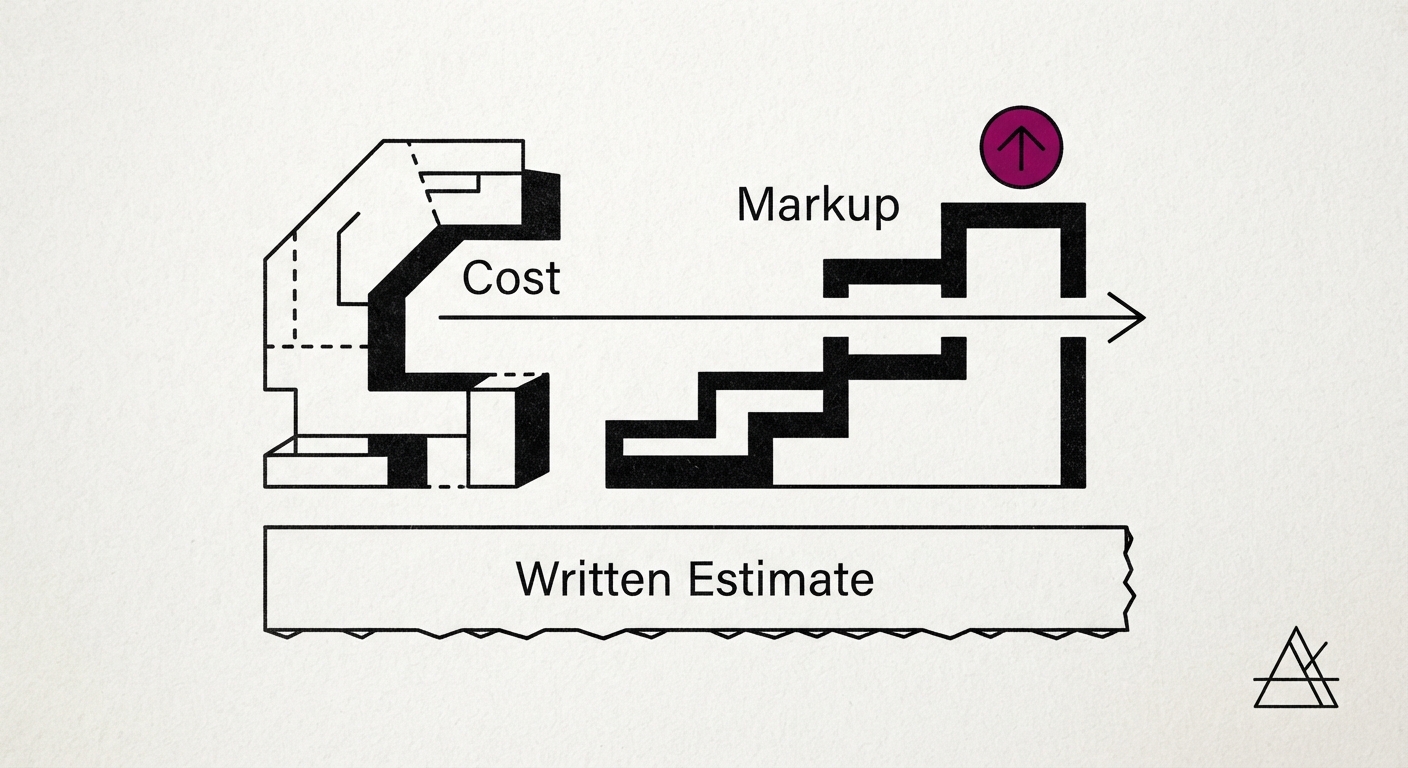
Before building the list, decide how it will bill that labor. Hourly pricing bills the time a technician spends on site. Flat-rate pricing quotes a fixed price per task, built from the expected hours plus a load for overhead and margin. That choice decides how your list is laid out.
Under flat rate, the cost per task is only as good as the hour estimate behind it. A bad estimate does not stay on one job. It carries into every invoice that uses the line, which is why the hours behind each line deserve more scrutiny than the final labor price.
Hourly fits open-ended diagnostic work, where nobody can know the hours until the technician has looked. Flat rate fits repeatable jobs, where your own history already tells you how long the work takes. Most shops end up with both on one list.
An hourly rate underlies both methods. A flat-rate line is just that rate multiplied by expected hours, so the labor price can be traced back to the same number either way. For price book construction and markup, see our guide to flat rate pricing, price books, and markup strategies.
Under flat rate, the cost per task is only as good as the hour estimate behind it.
Build your hourly labor rate from your own books
That shared number is the one to build first. Start from fully loaded technician cost: wage, payroll taxes, insurance, truck, tools, and the benefits you actually pay. Pull each figure from your own payroll and accounting records, not from an industry average. These are your real labor costs.
Then divide by billable hours, not paid hours. Drive time, call-backs, parts runs and dispatch gaps are all paid but never billed. That gap is where a labor rate set too low comes from. If you divide by paid hours, the rate looks fine and the shop still loses money every day.
Next add overhead and your target margin. Test the result in a spreadsheet or calculator before it goes on any invoice. Change the billable-hours assumption and watch what happens to the total cost per hour.
Treat the service call fee, emergency repair work and after-hours premiums as their own priced lines, each with a stated reason. Folding them quietly into the hourly rate hides what the customer is paying for and makes the rate hard to defend.
If you want to compare your rate with an average cost or a market rate, use a named publisher and year, such as a 2025 or 2026 edition of a trade survey. We have not tied this article to one, so no market number appears here. When you find a source, cite it on your own page the same way.
Then divide by billable hours, not paid hours.
What goes on the list: jobs and their labor hours
With the rate in hand, group the lines by job type. A workable set of groups is drain cleaning and clogs, faucets and fixtures, valves and supply lines, leak repair, water heaters including tankless, repiping, and optional water treatment. Those groupings reflect the job categories that pages already ranking for this keyword use.
Each line carries labor hours, a labor price, and a separate materials note. The labor price is the hours multiplied by the hourly rate you built in the previous section. Keeping materials on their own note means a parts price change never forces you to rework the labor math.
Leave the labor hours and labor price blank on every line until you fill them from your own job history, not from ours.
Plumbing repair cost on a given line depends on the shop's own records. Price jobs with multiple fixtures per fixture count only if those records show setup time is shared across them. If the second faucet takes as long as the first, the shared-setup discount is a loss.
Water softener, water filtration and hard water work is an optional add-on block. Include it only if your shop sells it. A line you never sell is clutter that makes the rest of the list harder to read.
What moves the price of a job
Even a well-built line needs adjusting from one house to the next. Setting rules for those adjustments is better than improvising them at the kitchen table.
Access drives hours. Work through a slab, under a floor, or behind drywall adds opening and patch work that a bare-fixture line does not include. Price that extra labor as its own line or its own multiplier.
Pipe material and condition matter too. Galvanized pipe, corrosion and pinhole leaks can turn a repair into a repiping quote. If you quote a specific claim about a pipe material, such as how fast galvanized pipe corrodes, cite the code or manufacturer source for it. Otherwise keep the rule to what your own jobs show.
Licensing and code requirements set who may do the work and how much inspection time to allow. They differ by state and by city, so check your own licensing authority for what a plumbing license requires and what a licensed plumber must handle. This article names no state.
Service areas affect drive time. Price that as a zone rule rather than absorbing it, so a far-edge job does not quietly cost you more than a job next door.
State these cost factors once, as adjustment rules your dispatcher can apply the same way every time. When the factors affecting the price live in a written rule, the price depends on the job and not on who answered the phone. Whatever the plumbing system looks like on arrival, the costs include the same categories, and the rule says how each one adds to the line.
Access drives hours.
Pay the technicians in a way that matches the price list
Labor pricing and technician pay interact. If technicians are paid by commission or on flat-rate hours, a price list built on hourly assumptions can end up paying them for time the shop never billed. The reverse can happen too: the shop bills hours it never pays for.
Check that the pay structure and the list assume the same hours for the same job. If they disagree, one of them is wrong, and the shop absorbs the difference on every ticket until someone notices.
For how each structure works, and what it does to behavior in the field, read our piece on technician performance pay, commission, and hourly pay structures.
Check that the pay structure and the list assume the same hours for the same job.
Check the list against what you actually earn
A list is a hypothesis. Test it by taking a sample of the shop's last invoices and comparing the billed labor with technician hours on those same jobs. Where the two diverge, either the hours on the list or the rate under it is off.
This comparison uses only your own invoices and time records. The method is the same one our audit uses.
The Anchorfield audit is a read of an owner's own numbers to find where pricing and labor diverge. We have not yet delivered one to a home services company, so we claim no findings from it. We have built ERP software for an import business, a more complex operation than a home services company, so reading a business's records end to end is not new to us. What we can describe is the method and what it looks at.
That is also why a vendor's pitch built on a general promise, such as more leads, is not the same thing as a read of your books. A promise like that never looks at your invoices. We make the full case on our page, a sales pitch is not a diagnosis.
A list is a hypothesis.
How much do plumbers charge for a day?
There is no standard day rate. A day's charge is the hourly rate times billable hours, plus any flat-rate jobs completed.
Billable hours are usually fewer than hours worked. We give no dollar figure here because we have no named, dated survey to cite.
How to tell if your plumber is overcharging you?
From the customer's side, a bill feels too high when it contains an unexplained service call fee, an hourly charge on a job that was quoted flat, or no line breakdown at all.
A customer's best check is a written quote before work begins. The contractor's defense is a price list he can explain line by line from his own costs.
What is the going rate per fixture for plumbing?
Per-fixture pricing is a convention that mainly applies to new construction and rough-in work, while repair work is usually priced per task. We state no going rate because we have no named, dated source for one.
To work out your own per-fixture price, take the hours per fixture times your labor rate, then add materials.
Why is hiring a plumber so expensive?
The hourly rate pays for far more than the technician's wage. It also covers the truck, insurance, licensing, tools, dispatch and the unbilled hours between jobs.
Emergency and after-hours work costs more because it takes a technician off his regular schedule. That is a stated reason the owner can give the customer.
Key Takeaways
A plumbing labor price list is hourly rate times labor hours for each job type, with materials listed separately.
The hourly rate comes from fully loaded technician cost divided by billable hours, not paid hours.
Access, pipe condition, code requirements and service area change the hours, so they need written adjustment rules.
Technician pay and the price list must assume the same hours for the same job.
Test the list against your own recent invoices and time records before trusting it.
Where to go from here
Pull last month's invoices and compare billed labor against technician hours on the same jobs. That one comparison tells you more about your list than any market average.
The Anchorfield audit does that comparison across your own numbers. It is the same audit described above, and it suits an owner who wants a read of his pricing and labor before spending on anything else. The decision is yours.
One more thing belongs on the same page as the price list: the rules for how you schedule plumbing work and dispatch it. Hours on the list only hold if the schedule lets technicians work them.
You already know something is wrong.
Ninety seconds will tell you how big it usually is.