What an HVAC pricing guide for contractors has to answer
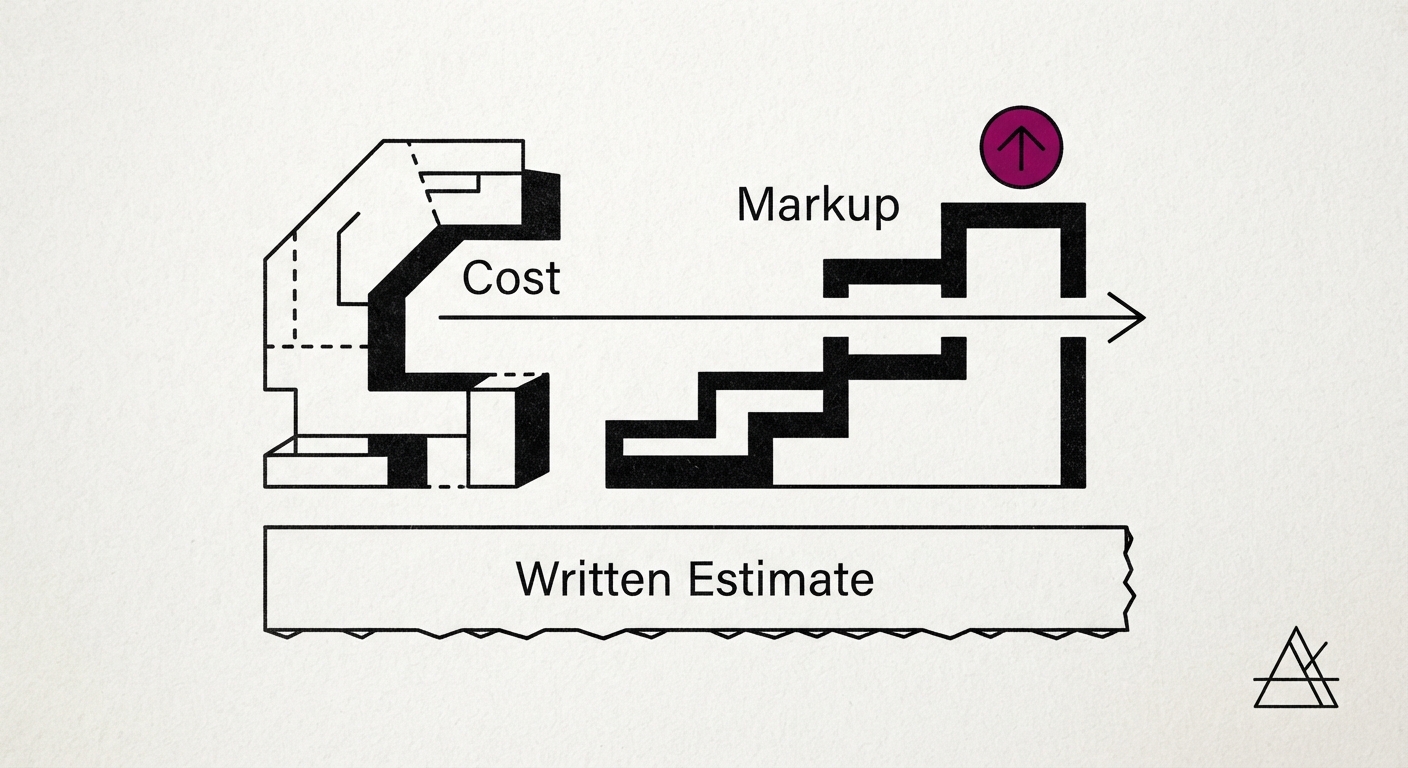
This guide prices from your own costs, not from an average another company published. A contractor's price has to come from his own full cost plus the profit he wants. A market average only tells you where you sit against other shops, and it says nothing about whether your jobs make money.
The order of the guide follows how a price is actually built. First comes full cost. Then markup against margin, then what changes the price on a job, then the price book, and last the quote a homeowner reads.
This HVAC pricing guide gives no regional price table and no market dollar figures. A number appears only as arithmetic worked in the article, and it is labelled as an illustration. Anywhere else, the honest answer is that the figure depends on the shop.
That matters if you run an HVAC business doing a few million a year. Pricing strategies copied from another HVAC company carry that company's overhead, wages and warranty exposure with them. Every HVAC contractor has to start from his own numbers, and the rest of this piece shows how to read them.
A contractor's price has to come from his own full cost plus the profit he wants.
Start with full cost: overhead, labor, and equipment
A price is only as good as the cost it was built on, and most shops leave something out of that cost. Full cost per job is equipment cost, labor cost, and an overhead share. Costing a job on equipment and labor alone is where the leak usually starts.
Overhead covers vehicles, insurance, office staff, licensing, software, and warranty callbacks. None of it shows up on a purchase order for a given job, so it gets forgotten when someone prices quickly.
Here is the calculation, with numbers invented for illustration and not taken from any real shop. Say annual overhead is $400,000 and the shop's technicians bill 8,000 hours a year. Divide one by the other and the overhead rate is $50 per billable hour. A job that takes six billable hours carries $300 of overhead before a dollar of profit is added.
Labor costs need the same care. The loaded cost of a technician is his wages, payroll tax, benefits, and the unbillable drive and shop time, all divided by his billable hours. Suppose a technician is paid $30 an hour and bills only 70% of his paid hours. On wages alone he costs the shop about $43 per billable hour, before payroll tax and benefits.
How the technician is paid changes that labor line and also what he is motivated to sell. That is its own subject, covered in technician performance pay, commission, and hourly pay structures, so it is not repeated here.
Warranty cost belongs in the price too. A manufacturer's parts warranty does not cover the contractor's labor to return to the job. If a compressor fails in year three, the part may be free and the technician's day is not. Build a warranty allowance into the price instead of absorbing it later.
License fees, bonding and the cost of keeping licensed contractors on staff sit in overhead as well. Add them to the pool before you divide.
A price is only as good as the cost it was built on, and most shops leave something out of that cost.
Markup is not margin
Once full cost is settled, the next mistake is in how the profit gets added. Owners set a markup they think is a margin, then keep less than they planned. The two numbers measure different things. Markup is a percentage of cost. Margin is a percentage of the selling price.
The arithmetic makes it plain. Take a part that costs $100 and mark it up 50%. The price is $150, and the profit is $50. That $50 is 33.3% of the $150 price, so the margin is 33.3%. The sum is 50 divided by 150.
To hit a target gross margin, work backwards the other way. Divide cost by one minus the margin. For a 40% target margin, divide cost by 0.60. As an illustration, a $600 cost divided by 0.60 gives a $1,000 price, which is a markup of about 66.7% on cost.
Equipment, labor and sub-contracted work are often marked up at different rates. Know which line carries the margin on a given job, because a discount taken off the wrong line can erase it.
Whether a target is realistic depends on the shop's overhead, so this guide quotes no industry margin figure. A 40% gross margin that covers one shop's overhead may fall short in another. Profitability is what remains after your own overhead rate is paid, and the only way to know it is to run your own numbers. A markup that looks cost effective on paper can still lose money if the margin underneath it is thinner than you assumed.
Markup is a percentage of cost.
What actually moves the price on a replacement job
With the cost and margin arithmetic in hand, the next question is what the job itself adds. Square footage alone does not set a system price. Tonnage comes from a load calculation, and ACCA's Manual J is the industry's published residential load method. Two homes of the same size can need different equipment because of insulation, windows, orientation and air leakage.
So the size of the system is a result, not a starting point. A contractor who sizes an HVAC system by square footage is guessing, and an oversized unit that short-cycles costs the homeowner comfort and the contractor a callback.
Efficiency level moves equipment cost. The customer's lower energy bills depend on climate, how much the system runs, and the condition of the old unit. If you quote savings, take the rating or savings figure from the manufacturer's or the Department of Energy's own published pages and name it. Do not round it up from memory.
Existing duct condition changes the scope. Ductwork, airflow, sealing and insulation can add work or remove it, and ductwork is the line most often left off a quick estimate. A system that moves air badly through leaky duct will not deliver the energy efficiency the equipment promises.
Furnace, AC and heat pump jobs differ in their parts. A furnace swap involves the heat exchanger and venting. An air conditioner or heat pump job turns on the refrigerant type and charge, the line sets, and the controls. Heating and cooling equipment each add their own labor and material lines, so price each as its own build-up.
Local rebates and permit rules change the final cost to the homeowner. Check the current utility or state program page itself instead of quoting a rebate from memory, since programs change. This guide names no specific program for that reason.
Each variable above is a line you decide to include, price and explain.
Square footage alone does not set a system price.
Flat-rate pricing and the price book
A price book turns full-cost math into one repeatable price per job. Flat-rate pricing quotes a fixed price per task, built from average time, parts and overhead, instead of billing hours on the clock. The customer knows the number before work starts, and the shop is paid for the task, not for how fast or slow a given technician happened to be.
The price book lists each task along with its cost build-up. That way the price can be rebuilt when parts or wages change, instead of being a number nobody can explain. It can live in a spreadsheet or in field-service software.
Tiered offers let the customer choose without the technician discounting. Present entry-level, mid-range and top-tier options for the same job, plus bundles and upgrade add-ons. A customer who picks the middle option has made a decision. A customer who haggles a single price has only negotiated.
Review the book on a schedule. Seasonal demand and supplier price changes are the usual triggers, and software can automate the update from supplier costs so the book does not go stale. A book last revised two years ago is pricing 2026 work with old numbers, so set a review schedule and keep to it.
Other trades lay out their labor lines in ways worth studying. The plumbing labor price list shows how one trade structures them, and HVAC can borrow the structure, though not the numbers, since the work and the costs are different.
No downloadable template is offered on this page. If you want an editable one, build it from your own cost build-ups, because a template filled with someone else's figures defeats the purpose.
A price book turns full-cost math into one repeatable price per job.
Writing the quote the homeowner will compare
The price is only half of a quote. The other half is presenting it so a homeowner holding three quotes can see what he is buying.
A good HVAC quote lists the equipment model and efficiency, the scope, the duct work, permits, warranty terms for both parts and labor, and the total. Each line is something a competitor's quote may have quietly left out.
A homeowner gathering three quotes compares totals first, then scope. A quote that names model, scope and warranty survives that comparison better than one with a single number. The single number looks cheap or expensive and gives no way to tell why.
Use the words quote and estimate carefully. A quote is a firm price for a defined scope. An estimate is an approximation. Tell the customer which one he is getting, because cost estimates that quietly harden into quotes cause most of the arguments at the invoice stage.
Upfront pricing, honored on the invoice, supports the customer experience. When the scope changes, put it in a written change order so both sides know what the new number covers.
Homeowner-side red flags are worth knowing, because your competitors are measured against them: no itemization, a pressure deadline, a missing license number. A quote that avoids all three stands out. This guide cites no consumer guide for that list, because it describes how we read the problem, not a published standard.
Regular maintenance agreements are priced as a separate line from the install. They cover the HVAC service work that comes after it, and keeping them apart makes both the install price and the agreement easier to defend.
A quote that names model, scope and warranty survives that comparison better than one with a single number.
Price is a symptom: why a pricing guide is not a diagnosis
Fixing the price sheet may not fix where margin is leaking. A rate change or a markup change addresses one possible cause. Missed callbacks, discounting, dispatch gaps and unbilled time can sit behind the same thin margin, and our own audit methodology treats pricing as one place to look among several.
That is the difference between selling a fix and diagnosing the problem, and it is the argument of a sales pitch is not a diagnosis. A vendor who sells you a new price book has already decided the price book is the problem.
Here is what is true of Anchorfield. No home-services audit has been delivered yet. We have built ERP software for an import business, a more complex operation than a home services company, so reading a business's records end to end is not new to us.
That is the whole claim. We are not reporting outcomes or findings from home services shops, because we have none to report.
Fixing the price sheet may not fix where margin is leaking.
What is the $5000 HVAC rule?
The $5,000 rule is a homeowner rule of thumb for repair versus replace: multiply the unit's age in years by the repair quote, and if the result is above $5,000, replacement is the better choice. It is widely repeated, and we name no source for it.
For the contractor, it explains why a customer balks at a large repair quote on an old unit. A written replacement option next to the repair price answers that.
It is a rule of thumb, not a standard, and it should not be presented as an industry rule.
How much does a new HVAC system cost 2000 sq ft?
No dollar figure is given here, because square footage alone does not set a system's size or price. The load calculation decides tonnage, and ACCA's Manual J is the published method for it.
For a 2,000 sq ft home, the price depends on tonnage, efficiency level, single- or multi-stage equipment, duct condition, and local labor cost. We quote no cost range for that reason.
A contractor prices this job from his own price book and full cost, not from an average.
How to price HVAC services?
Build each price from your own cost, then add the profit you need.
Work out full cost per task: labor, parts and overhead share. Apply a markup that delivers the target margin, not a markup copied from another shop, using the divide-by-one-minus-margin arithmetic from the markup section.
Put the result in a price book as a flat rate with good, better and best options. Review the book on a schedule and whenever supplier or wage costs move.
How much does a HVAC contractor charge per hour?
No market hourly rate is stated here. Rates vary by metro, and we have no named source for one.
Your own rate is built up from three pieces per billable hour: loaded technician cost, plus the overhead rate, plus target profit. The full-cost section above shows the overhead arithmetic.
Many contractors quote flat-rate jobs instead of an hourly rate, so the hourly figure is mostly an input to the price book.
Key Takeaways
Price from full cost: equipment, loaded labor, and an overhead share per billable hour.
Markup and margin are different. A 50% markup is a 33.3% margin.
Tonnage comes from a load calculation (ACCA Manual J), not square footage.
A price book turns cost math into a repeatable flat rate, with tiered options.
A quote that names model, scope and warranty holds up when a homeowner compares three.
A thin margin can have causes a price sheet will not reach, and diagnosis comes before the fix.
Where an Anchorfield audit fits
The Anchorfield audit reads a company's own jobs, pricing and dispatch data to find where margin is lost. The /method page describes how it works.
As stated above, no home-services audit has been delivered yet, and no outcomes are claimed.
The owner who needs it is the one who has rebuilt his price book and still sees thin margins. At that point the price is no longer the likely cause, and the next step is finding what is.
You already know something is wrong.
Ninety seconds will tell you how big it usually is.