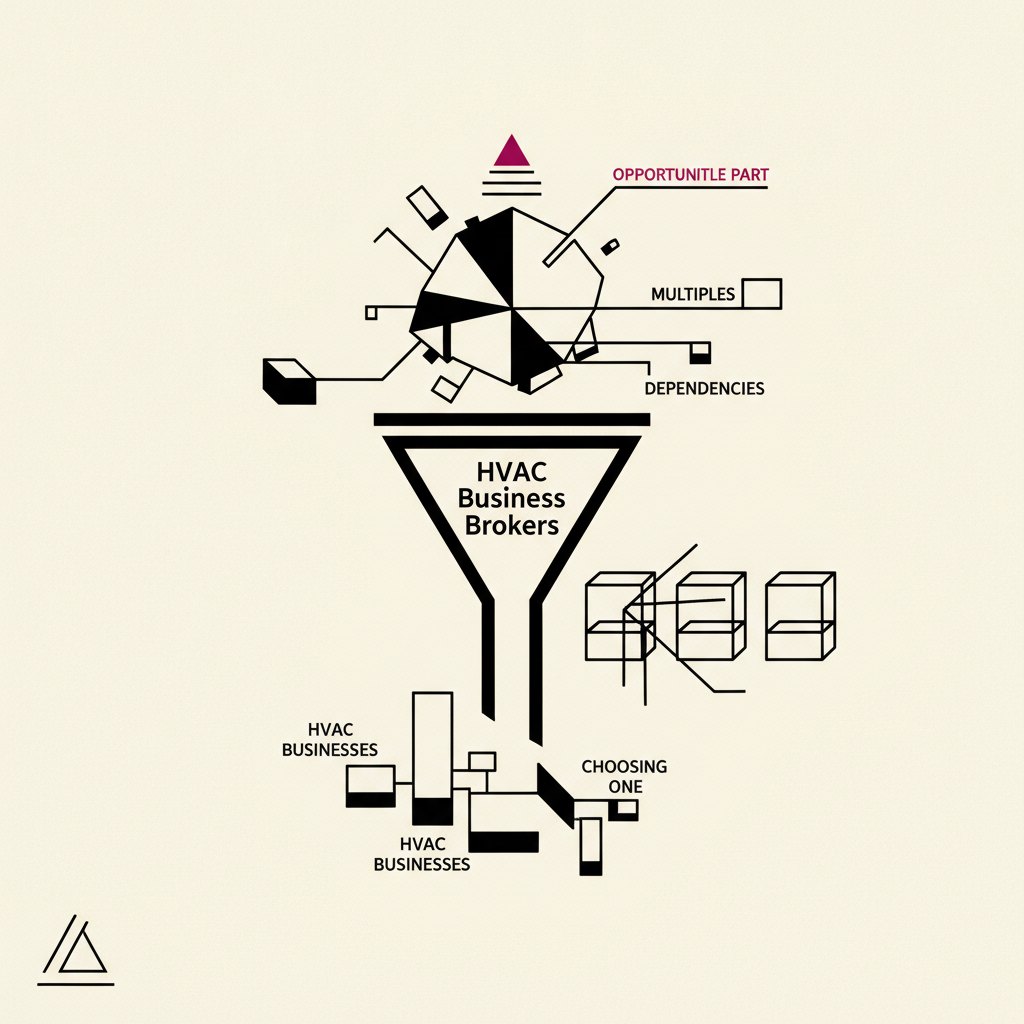
What an HVAC Business Valuation Calculator Actually Estimates
Type revenue or earnings into an hvac business valuation calculator and it applies a single multiple, and out comes a number that looks precise. It isn't. A calculator that takes one line of earnings and multiplies it can't see recurring revenue mix, customer concentration, or the condition of the trucks and equipment sitting in the yard, and all three move the real number more than the multiple it started with.
Anchorfield has not built or published a free hvac business valuation calculator, and nothing here claims to output one. What follows is the set of inputs a legitimate calculator, or a broker's own estimate, would actually need before its number meant anything.
The question most owners are really asking, how much is my hvac business worth, what does my hvac business value actually come out to, isn't a single figure at all. It's a range, and where you land in it depends on which earnings figure gets used and which multiple convention gets applied. Both are covered in the next section.
So when a rough estimate from a free calculator says your company's value is some round number, treat it as a starting point for a conversation, not an answer. A calculator provides a shape. It doesn't provide an accurate valuation of your business value, or anyone else's.
A calculator provides a shape. It doesn't provide an accurate valuation of your business value, or anyone else's.
How the Multiple Is Built: SDE, EBITDA, and What They're Applied To
Small home services businesses are commonly valued as a multiple of Seller's Discretionary Earnings, and larger ones as a multiple of EBITDA. Where the line falls depends on the buyer and the advisor, and we state no dollar threshold because we have no named source for one. This is standard small-business M&A convention, as used by business brokers and M&A advisors and documented by the International Business Brokers Association. The two earnings figures aren't interchangeable, and a valuation report that doesn't say which one it used hasn't told you much.
Whatever multiple gets applied, it produces enterprise value, the number before debt, cash, and working capital adjustments get made. Enterprise value is not the check an owner walks away with at close. A serious valuation report states both figures separately rather than presenting one number as if it were the other.
No single HVAC-specific multiple range is asserted here, because none was supplied with sourced data to back it up. A credible valuation report names its comparable transactions or its survey source. A bare number with no source behind it is a guess wearing a suit, whether it comes from a free hvac business valuation calculator or a broker who wants your listing.
And a higher multiple isn't a separate lever you pull at the end of the process by asking nicely. It's the output of specific, checkable factors, covered in the next section, not something a seller can request from a broker or write into a listing to get a higher valuation.
Enterprise value is not the check an owner walks away with at close.
What Actually Moves an HVAC Business's Multiple Up or Down
A book of maintenance and service agreements that renews every year without a sales call is treated by buyers as recurring revenue, and it typically supports a higher multiple than a business built entirely on one-off install or repair calls. The reason is simple: recurring service income is revenue a buyer can underwrite with more confidence than the next quarter's unknown call volume.
Customer concentration works against the multiple. A business where a handful of commercial hvac accounts make up a large share of revenue reads as riskier to a buyer than one with a broad residential customer base, because losing a single account moves the numbers materially. Two businesses with the same trailing earnings can carry very different risk profiles for exactly this reason.
Buyers also price in the average age and condition of company vehicles and hvac equipment as near-term capital expenditure they'll have to absorb after close. That expense gets subtracted from headline earnings during diligence, not added to them. A fleet of aging trucks and worn shop equipment is a discount, not a footnote.
And two hvac businesses with identical trailing earnings can still carry different multiples because of how the business runs day to day. One owner is the business. Every estimate, every callback, every hard decision is routed through him. The other has technicians and a dispatcher who can run the operation without him standing there. Buyers pay for the second version and discount the first, regardless of what similar hvac businesses in the same market are doing, because it's the individual business's own structure that gets priced, not the industry's.
Buyers pay for the second version and discount the first, regardless of what similar hvac businesses in the same market are doing, because it's the individual business's own structure that gets priced, not the industry's.
Why 'Typical' Valuation Ranges Vary So Much by Business
Published claims that hvac businesses sell for X to Y times earnings compress companies of very different sizes and risk profiles into one number. No such range is asserted in this article, because the brief and the underlying keyword data behind it supplied none with a named source, and a number without a source isn't worth repeating.
A business listed for sale through a broker with a documented earnings trend and clean books tends to draw tighter, higher bids than one marketed informally with unverified numbers, independent of whether the underlying business is actually better. Presentation and documentation move the market valuation a buyer is willing to accept, even before anyone starts negotiating the multiple itself.
A very small hvac business is often valued closer to a job with goodwill attached than a company in its own right, because much of its value is the owner's personal relationships and licenses rather than a transferable system. We state no dollar line for where that happens, because we have no named source for one. That distinction matters enough that the FAQ questions below return to it directly.
Presentation and documentation move the market valuation a buyer is willing to accept, even before anyone starts negotiating the multiple itself.
Who Actually Sets the Number: Brokers, M&A Advisors, and Buyers
A local business broker prices a deal against comparable small-business sales in the region. An M&A advisor working a platform or add-on deal prices against strategic buyer appetite instead, and that appetite can produce a substantially different number for the same business than the broker's regional comp set would.
Private equity-backed consolidators buying hvac companies as roll-up platforms typically pay a premium multiple over what a single local buyer would offer, because they're pricing in the operating leverage of folding the business into an existing platform, not just its standalone earnings. That dynamic, and what it means for due diligence on the seller's side, is covered in full in our piece on private equity consolidation, roll-ups, and acquisition due diligence.
The same business can draw genuinely different offers from a strategic buyer, a financial buyer, and an individual operator-buyer, because each one is solving a different problem with the acquisition. A strategic buyer wants the customer base and the territory. A financial buyer wants the cash flow. An operator-buyer wants a job he can run himself. None of the three is pricing the same thing, even though they're all bidding on hvac deals in the same industry.
None of the three is pricing the same thing, even though they're all bidding on hvac deals in the same industry.
Building Value Before You're Ready to Sell
Owners who want to sell their hvac business for more in five years get more leverage from fixing customer concentration and building a management layer now than from any last-minute dressing up of the books before a broker walks through. The factors that move the multiple, recurring revenue, owner dependence, customer spread, take years to change, not months.
An owner who intends to hand the business to a family member rather than sell it externally still needs to know what it's worth, because succession and buyout terms usually get priced off the same earnings-multiple logic used in an outside sale. Our piece on succession planning for trade business owners covers that path specifically, including where it diverges from a straight third-party sale.
Owners who want to sell their hvac business for more in five years get more leverage from fixing customer concentration and building a management layer now than from any last-minute dressing up of the books before a broker walks through.
When You're Actually Ready to Sell
The mechanics in this article, SDE versus EBITDA, recurring revenue, customer concentration, owner dependence, apply the same way across HVAC, plumbing, electrical, and roofing businesses, not just to hvac specifically. An owner selling hvac and an owner selling an hvac-adjacent plumbing outfit are working from the same playbook.
A sale price agreed in a letter of intent is not final. It's typically adjusted at close for working capital and for any earnings quality findings that come out of buyer due diligence, which is exactly where an owner's own numbers get tested against what he told the broker at the start of the process.
Owners running these numbers for their own company tend to land on a handful of specific questions, each turning on the same size-and-earnings logic covered above.
A sale price agreed in a letter of intent is not final.
How much is a business worth with $500,000 in sales?
Revenue alone doesn't set value. A business with $500,000 in sales and thin margins is worth less than one with $500,000 in sales and strong SDE, because the multiple gets applied to earnings, not to top-line revenue, standard SDE valuation convention, per the International Business Brokers Association.
No dollar figure is given here for what that specific business would sell for, because that depends on its actual earnings and the factors covered above, not on revenue viewed in isolation.
How much is an HVAC business worth?
It's set by applying a multiple to the business's SDE or EBITDA, adjusted up or down for recurring revenue share, customer concentration, equipment condition, and owner dependence. Those are the same mechanics covered above, not a single industry-wide number that applies regardless of the business behind it.
How much is a business worth with $1,000,000 in sales?
As with the $500,000 example, sales volume alone doesn't answer this. What matters is the earnings that revenue actually produces after normalizing owner compensation and one-time expenses. That normalized figure, not the sales number, is the starting point the multiple gets applied to.
How much is a business worth that makes $300,000 a year?
If $300,000 refers to SDE, that business sits at a size where most buyers are individual operators rather than platforms or PE-backed consolidators, and that pool of buyers typically caps the multiple lower than what a $1M-plus SDE business with recurring revenue can command.
That's a size-driven ceiling, not a fixed industry number. The same business, with the same characteristics but a larger earnings base, would draw a different set of buyers entirely.
Key Takeaways
A valuation calculator output is a rough estimate built from limited inputs, not a substitute for a broker or M&A advisor's assessment.
Businesses are valued as a multiple of SDE, for smaller companies, or EBITDA, for larger ones, not as a multiple of revenue.
Recurring service agreements, low customer concentration, and reduced owner dependence raise the multiple; owner-dependent, one-off-job businesses depress it.
Private equity-backed consolidators typically pay a premium over individual local buyers because they price in platform synergies, not just standalone earnings.
No single claim that hvac businesses sell for a fixed multiple of earnings is asserted in this article, because no sourced figure supports one.
The same valuation mechanics apply across HVAC, plumbing, electrical, and roofing businesses.
Get a Real Number Before You Guess
An Anchorfield audit looks at the operational factors covered above, recurring revenue mix, customer concentration, owner dependence, inside one specific business. That's the input a calculator can't see and a broker's estimate has to assume rather than verify.
If you want that specific number for your own shop rather than a calculator's rough estimate, you can book a discovery call and find out what actually moves it.
That's the input a calculator can't see and a broker's estimate has to assume rather than verify.
You already know something is wrong.
Ninety seconds will tell you how big it usually is.