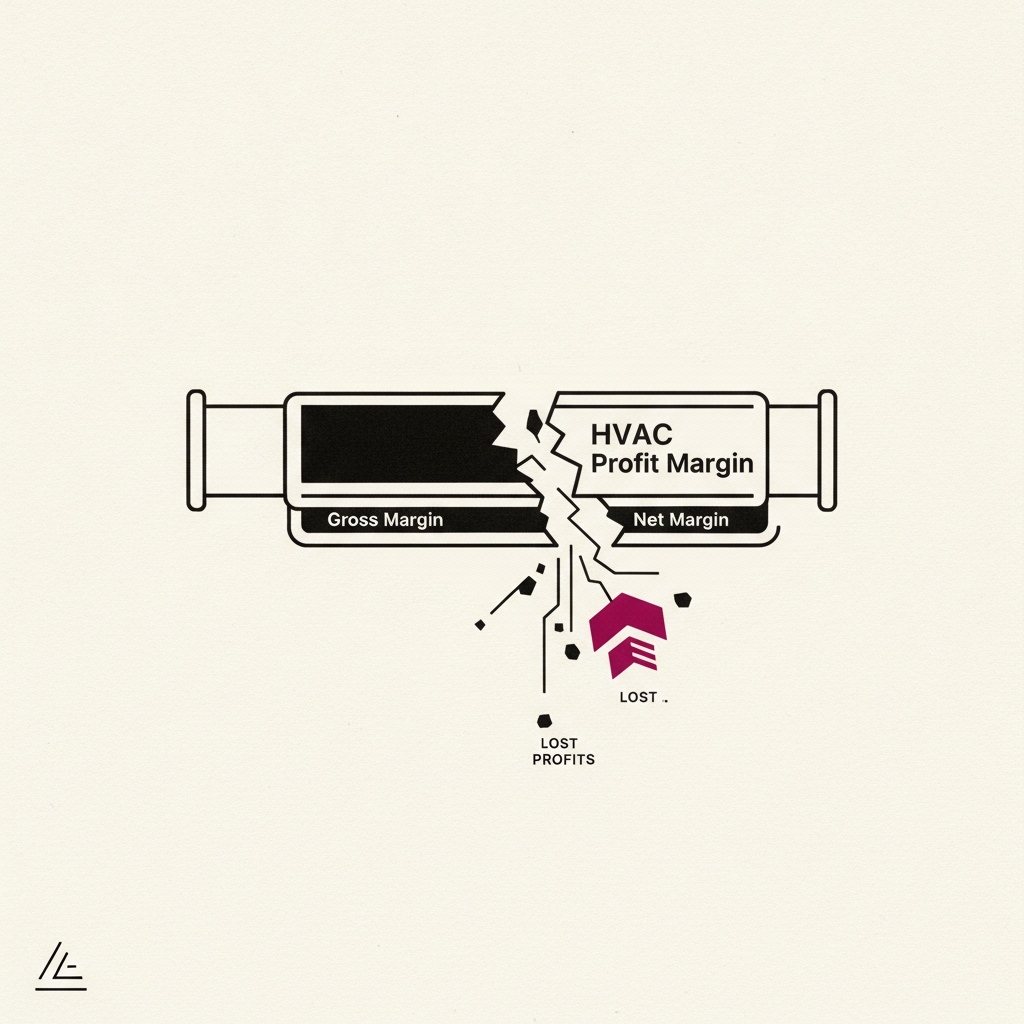
Why a Single Profit Margin Number Doesn't Tell You Much
Ask ten hvac business owners what their profit margin is and most will give you one number, pulled off the bottom of the year-end P&L. That number can be perfectly accurate and still hide the actual state of the business.
An hvac company can post a respectable company-wide margin while its install crew loses money on every job, propped up by a service department that's quietly carrying the whole operation. The average blends install, service and maintenance work with very different cost structures into one figure, and averages are good at hiding exactly the kind of problem an owner needs to see.
This is common across the hvac industry generally, not a sign that a particular shop is being run badly. It's what happens by default when margin is only ever looked at from the top down. This article works through the two margin figures that actually matter, gross and net, what typically makes up hvac overhead, and where job-level margin most often gets lost before it ever shows up on a P&L.
An hvac company can post a respectable company-wide margin while its install crew loses money on every job, propped up by a service department that's quietly carrying the whole operation.
Gross Profit Margin vs. Net Profit Margin in an HVAC Business
The two numbers get used interchangeably in conversation and they measure different things. Gross profit margin is revenue minus cost of goods sold - materials, direct labor on the job, subcontracted work tied to that specific job, divided by revenue. It's a standard accounting definition, not something specific to hvac, and it answers a narrow question: what does a job leave behind before the business pays for anything that isn't directly tied to doing that job.
Net profit margin goes further. It's what remains after overhead is also subtracted: office staff, admin software, marketing, facilities, insurance, owner salary if it's drawn as an expense rather than a distribution. Net margin is the number that actually answers whether the business is profitable, because a shop can have a strong gross profit margin on every job and still lose money once the office, the trucks and the software licenses are paid for.
There isn't a single universally cited average gross profit margin or average net profit margin for hvac companies that holds across residential, commercial, service-only and install-heavy shops. A credible number would need to come from a named source like ACCA or a ServiceTitan industry benchmark report, and until Anchorfield can point to one, this article won't assert a percentage as if it were fact.
What matters more for an individual owner than any external profit margin benchmark is knowing his own gross margin, his own net margin, and the gap between the two, because that gap is entirely made up of overhead, and overhead is the part of the P&L most owners have actually never broken down.
Net margin is the number that actually answers whether the business is profitable, because a shop can have a strong gross profit margin on every job and still lose money once the office, the trucks and the software licenses are paid for.
What Actually Sits Inside HVAC Overhead
Overhead is usually treated as one lump line item, which is exactly why it's hard to manage. In a typical hvac contractor's business, it breaks into a handful of real categories: office and dispatch staff wages, admin software and licensing, marketing spend, vehicle and facility costs that aren't tied to any one job, and insurance.
None of that shows up in a job's gross margin. It only shows up once you get to net. Labor burden is the piece most often undercounted, because it's tracked separately from base wage: payroll taxes, workers' comp, benefits. A shop that prices labor off wage alone, without loading in burden, will consistently think its jobs are more profitable than they are, because the true labor cost is higher than the number on the pay stub.
There's a second trap that gets mistaken for a margin problem and isn't one: cash flow. A shop that collects deposits before buying materials, runs payroll weekly, and gets paid net-30 on invoices can look like it's bleeding margin when the real issue is timing: money owed is sitting on the other side of a 30-day gap, not gone. A margin problem and a working-capital problem produce the same symptom (not enough cash on hand), but they need different fixes, and treating one as the other wastes time an owner doesn't have.
A margin problem and a working-capital problem produce the same symptom (not enough cash on hand), but they need different fixes, and treating one as the other wastes time an owner doesn't have.
Where Margin Gets Made or Lost: Job Costing
Job costing is the mechanism that turns a company-wide average into something an owner can actually act on. It means tracking actual labor hours, material cost and an allocation of overhead against each completed job, then comparing that to what was quoted. Without it, a shop only finds out its margin in hindsight, at the P&L level, months after the jobs that made or lost the money are done.
Install jobs and service or repair jobs typically carry different margin profiles, and averaging them into one hvac margin figure can mask an install department that's subsidized by service, or a maintenance program that's quietly losing money every visit.
Average ticket size, tracked job type by job type and technician by technician, is one of the clearest early signals of a pricing or upsell gap. Two technicians running the same kind of call with a meaningfully different average ticket usually means one of them is leaving money on the table, not that the jobs were different.
The common margin leaks worth checking directly: a flat-rate price book that hasn't been updated since the last material cost increase, callbacks and warranty work that get absorbed as a cost of doing business instead of being tracked against the original job's margin, and technician hours that go unbilled without anyone separating billable from non-billable time. Any one of these can quietly erode margins on every job a crew runs, long after the price book was set with a healthy margin in mind.
Install jobs and service or repair jobs typically carry different margin profiles, and averaging them into one hvac margin figure can mask an install department that's subsidized by service, or a maintenance program that's quietly losing money every visit.
Pricing and Revenue Mix Move Margin More Than Cost-Cutting Does
The instinct when margin looks thin is to cut cost. Often the bigger lever is pricing discipline and revenue mix, not expense reduction. Material cost is a pass-through when the price book is priced correctly and a margin killer when it lags supplier cost increases. That's a pricing problem showing up disguised as a cost problem.
The mix between residential hvac and commercial hvac work, and between service and repair versus new install, changes what a normal margin looks like for a given shop. A residential-heavy shop and a commercial-install-heavy shop are structurally different businesses, and comparing their margins directly, without adjusting for that mix, tells you nothing useful about either one.
A more actionable number than a single company-wide cost of goods sold percentage is cost of goods sold and labor tracked as a percentage of revenue, broken out by job type; that's what actually shows an owner where the pressure is coming from.
As with the gross and net margin figures earlier, there isn't a single reliable industry-wide figure for what profit margins in the hvac industry look like across that residential/commercial mix that this article can cite without a named source, so it won't manufacture one. The useful exercise is running this breakdown against a shop's own numbers, whether that shop does a million in revenue or twenty.
A residential-heavy shop and a commercial-install-heavy shop are structurally different businesses, and comparing their margins directly, without adjusting for that mix, tells you nothing useful about either one.
Who's Actually Watching These Numbers Month to Month
Most hvac company owners already have someone recording the numbers. A bookkeeper's job is to record transactions accurately: what came in, what went out, reconciled against the bank.
Deciding what a job-costing gap or a labor burden miscalculation actually means for next quarter's pricing is a different skill entirely, and it's not one bookkeeping is set up to do. That's the reason some owners bring in fractional cfo services for home service contractors once the business has outgrown what a single bookkeeper's scope was ever meant to cover, someone who reads the numbers a bookkeeper produces and turns them into a pricing or job-mix decision, rather than just filing them accurately.
A bookkeeper's job is to record transactions accurately: what came in, what went out, reconciled against the bank.
How to Find Out Where Your Own Margin Is Going
The gap between a shop's company-wide net margin and its actual job-level margins is usually invisible without pulling job costing data apart by job type, crew and season. That's not a task most owners have the hours to do themselves on top of running the business.
It's exactly what the Anchorfield revenue audit is built to do: look at a shop's own numbers, job by job and crew by crew, and show where the average is hiding a leak rather than telling an owner what the industry average supposedly is.
What is the HVAC $5,000 Rule?
It's a rough repair-versus-replace threshold for a homeowner's unit, not a business-margin metric. Multiply the estimated repair cost by the equipment's age in years — if that clears roughly $5,000, replacement is usually the better call than another repair.
There's no single authoritative source behind the exact figure; trade publications and consumer sites cite versions of it with the threshold moving depending on who's writing. Worth knowing if it comes up in a sales conversation with a customer, but it has nothing to do with how an hvac company should be reading its own gross or net margin.
Can an HVAC Technician or Owner Make $100,000 a Year?
That's a question about individual income, not business margin, and it's outside what this article can answer with the numbers on hand. Whether a technician, service manager or owner clears six figures depends far more on role, market, commission structure and ownership stake than on the trade itself.
Answering it responsibly would take a named wage source, like BLS data for the occupation — none was pulled together for this piece.
Is HVAC a Profitable Business?
Yes — and the mechanics in this article are the reason why. Hvac supports healthy net margins when job costing, labor burden and overhead are tracked at the job level, and pricing keeps pace with material cost increases.
The business model isn't the constraint. What an individual shop actually posts depends on whether those things are tracked and acted on, not some ceiling built into the trade — a shop flying blind on job costing with a stale price book will underperform a shop half its size that's watching both closely, in the same market, doing the same work.
Is a 70% Profit Margin Too High?
Almost always, a number like that is the gross margin on one specific job or service line, not the net margin for the whole business — the two get confused constantly. Labor-heavy repair work can post a very high gross margin because material cost is a small fraction of the ticket, and the labor is billed at a rate that covers far more than what the technician is actually paid.
That 70% says nothing on its own about the company's net margin once overhead, labor burden and the cost of jobs that ran under quote are subtracted out. A job type running at 70% gross margin can sit next to an install department barely clearing 15% in the same company, and both numbers can be accurate at the same time.
Key Takeaways
Gross margin measures what a job leaves behind before overhead; net margin measures what the business actually keeps after overhead is paid, and a healthy number in one does not guarantee the other. A company-wide margin average can hide individual job types, crews or seasons that are losing money, and job costing is the only thing that reliably surfaces that.
Labor burden, callback costs and a stale price book are specific, common places where margin leaks without showing up until the P&L closes months later. Residential versus commercial mix and install versus service mix change what a normal margin looks like for a given shop, so comparing raw margin percentages across shops with different mixes is comparing different businesses.
Recording the numbers accurately and interpreting what they mean for pricing and job mix are two different jobs: bookkeeping does the first, a fractional CFO or an audit does the second, and most owners are missing the second one entirely.
How to Find Out Where Your Own Margin Is Going
If you're an hvac business owner who isn't sure whether your own gross and net margins are where they should be, or which job types are actually carrying the business and which are being carried, that uncertainty is the whole reason to look at your own numbers rather than reach for an industry average that may not even describe a shop like yours.
The Anchorfield revenue audit exists for exactly that question. It looks at your numbers, not a benchmark pulled from a different mix of work in a different market.
You already know something is wrong.
Ninety seconds will tell you how big it usually is.